The fastest way to get clarity is to stop treating everyone as "the customer"
Early-stage discovery often feels fuzzy because "the customer" is a moving target. And segmentation alone isn't enough: Harvard Business Review reported that only 14% of executives got real value from their segmentation work — usually because it never revealed what each group actually wanted.
You might be talking to:
- people who feel the problem daily
- people who approve the purchase
- people who are adjacent but not core
- companies at totally different stages
If you blend all of that together, you'll get a pile of notes… but it's hard to decide what to do next.
A simpler mindset helps:
Your job in early discovery is to learn what each segment wants.
What "segment" means in practice (keep it lightweight)
A segment is just a useful grouping that changes what people want or how they behave.
For early-stage founders and founding PMs, the most practical segmentation usually comes from a few dimensions:
Person context
- role (user / manager / buyer)
- seniority
- what "success" looks like for them
Company context
- stage or size
- industry constraints (if relevant)
- tool stack / workflow maturity
You don't need to track everything. You just need to track the few things that explain why preferences differ.
Why segment-first discovery speeds up your product decisions
When you learn by segment, you start getting answers to the questions that actually drive roadmap and GTM:
- Which group has the strongest pain?
- Which group has urgency right now?
- Which group has budget or decision power?
- Which group would adopt something lightweight?
- Which group expects integrations and procurement?
The outcome is not "more research." The outcome is faster conviction.
A practical segment-first workflow (simple, not academic)
Step 1: Start with 2–4 candidate segments
Not 12. Not a huge taxonomy.
Example candidates:
- founders at pre-seed
- ops managers at 50–200 person teams
- PMs at product-led startups
- sales teams doing founder-led GTM
Step 2: Choose the attributes that separate those segments
This is the key: track whatever matters for your market.
Common high-signal attributes:
- role (user/buyer/manager)
- stage/size
- industry
- tool stack
- workflow maturity
- budget sensitivity
If you're still figuring out your segment, this step is your guardrail. It keeps you from mixing audiences and getting confused later.
Step 3: Capture "what they want" in a comparable format
After each conversation, capture:
- what they're trying to achieve
- what gets in the way
- what they do today
- what would make them switch
Then label it with the segment attributes.
Now when you review themes, you can look at them per segment instead of as one blended story.
The real unlock: "What does each segment want?"
A simple way to summarize each segment is:
Segment: who they are Job: what they're trying to do Pain: where it breaks Preference: what they want in a solution Constraint: what blocks adoption
This is how founders and PMs get out of the "everyone wants something different" feeling and into a clear decision.
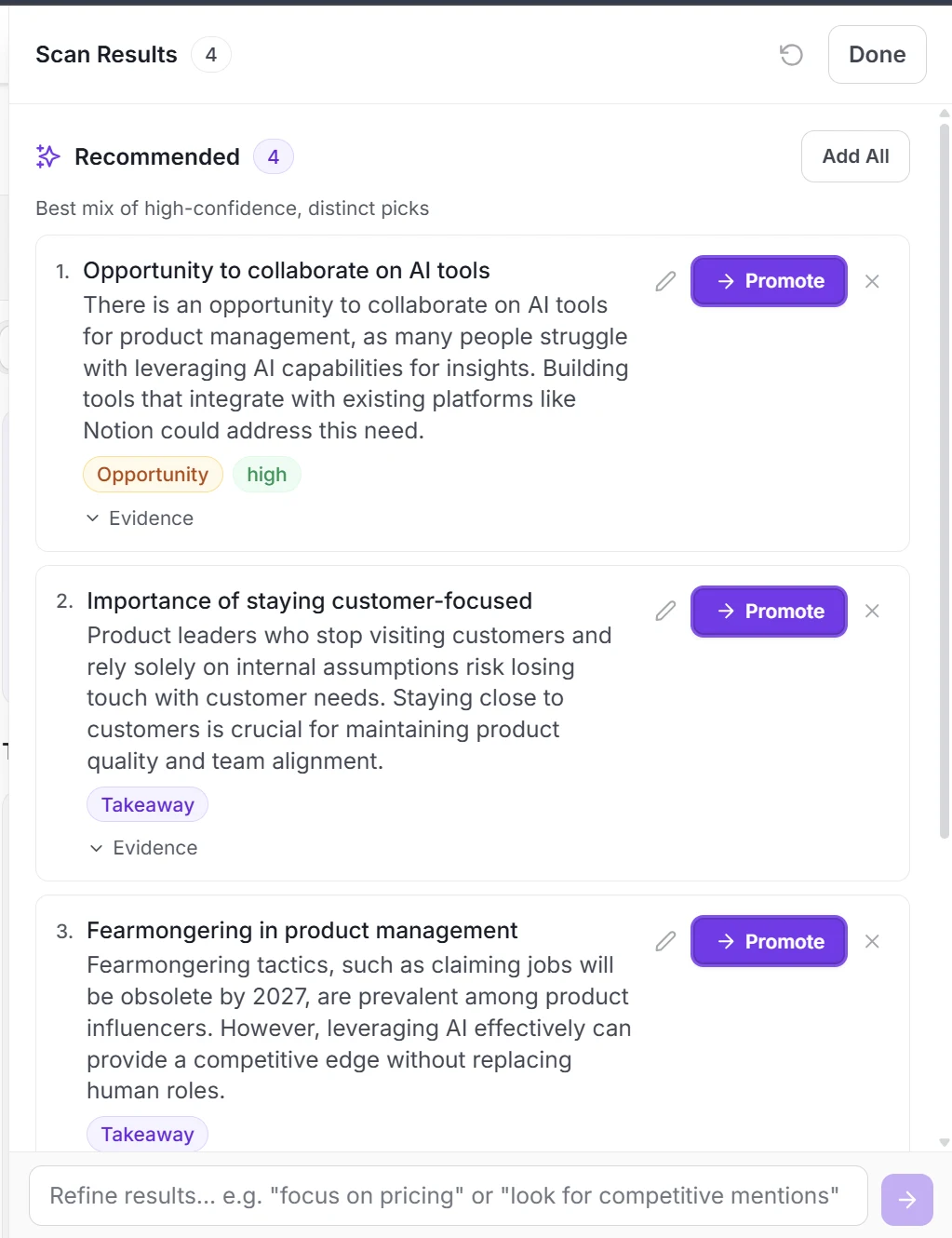
How Intervool fits
Intervool is built for segment-first learning:
- you can track the attributes you care about (not a fixed taxonomy)
- you can tie interviews and insights back to those attributes
- you can synthesize themes and view what's repeating for each segment
So instead of "we heard a lot," you get: "Segment A wants X, Segment B wants Y, and we're choosing A first."
If you're doing discovery right now, Intervool offers a 14-day free trial for early teams.