Each one below leads with the question it answers, because that's how you should be choosing. Sample sizes are working rules of thumb for product teams, not academic thresholds.
Customer interviews
QualitativeWhat problem do they have, and how do they deal with it today?
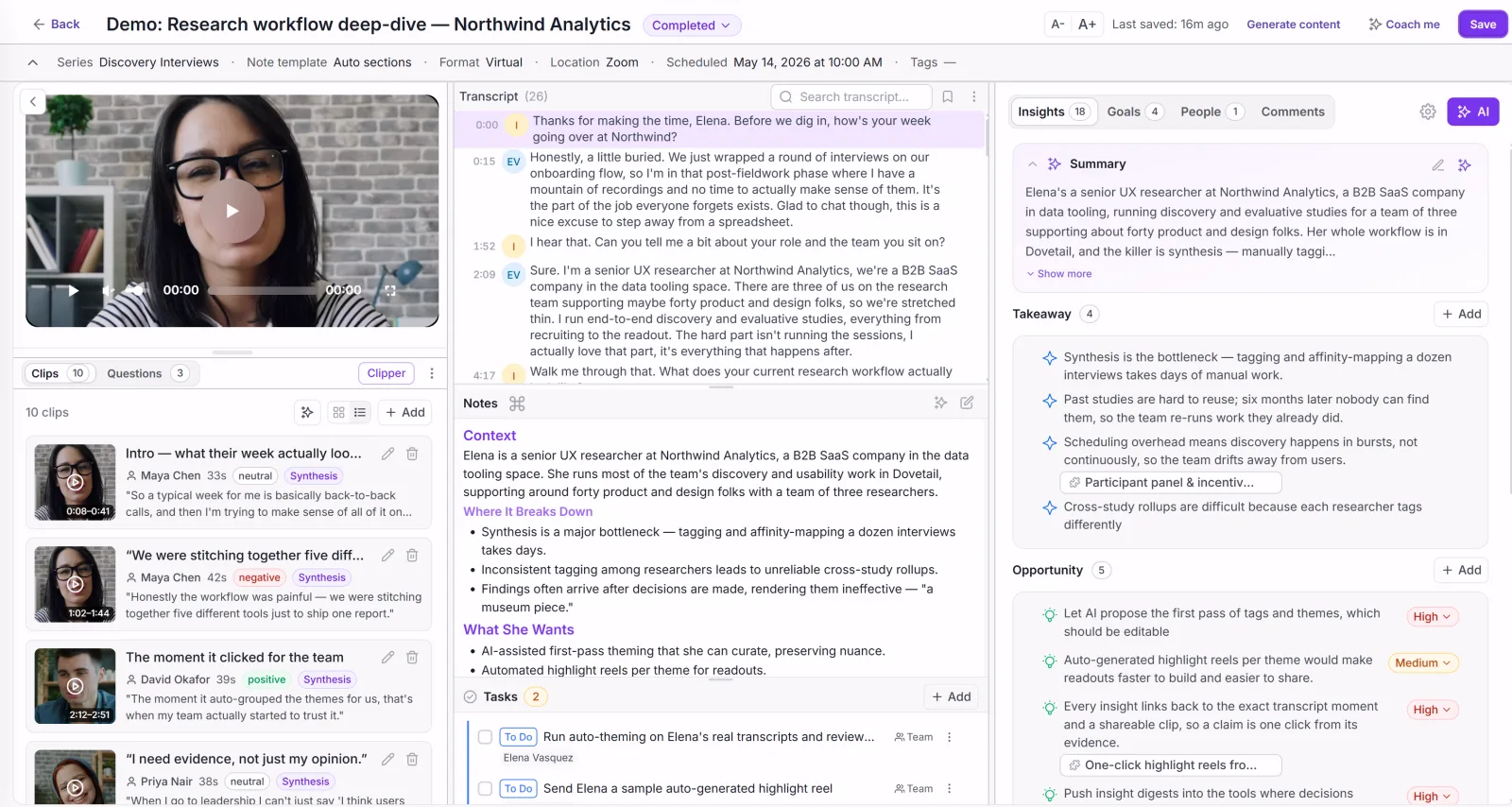
A semi-structured conversation, usually 30–45 minutes, where you ask about real past behavior rather than hypothetical preferences. It's the highest-yield method in the category and the one most teams should run first, because it's the only method that will surprise you — every other method tests something you already thought of.
- Sample size:
- 5–8 per segment to spot themes, 12–15 to trust them
- Watch out for:
- Leading questions and hypothetical framing. 'Would you use this?' invalidates the answer.
Jobs-to-be-done switch interviews
QualitativeWhat made them switch — and what nearly stopped them?
A specific interview structure that reconstructs a purchase or churn decision along a timeline: first thought, passive looking, active looking, deciding, first use. Because it anchors on an event that actually happened, it gets at the forces behind the switch — push, pull, habit, and anxiety — rather than a rationalized story.
- Sample size:
- 8–12 recent switchers (or churners)
- Watch out for:
- Interviewing people who switched too long ago. Under 90 days keeps the memory usable.
Contextual inquiry
QualitativeWhat do they actually do, in the place they do it?
Watching someone work through a real task in their real environment, asking questions as they go. It reliably surfaces the workarounds, spreadsheets, and side-channels people never mention in an interview because they've stopped noticing them. Expensive in time, and worth it exactly once per workflow you care about.
- Sample size:
- 4–6 sessions per workflow
- Watch out for:
- Turning it into an interview. Watch first, ask second, and let silences run.
Diary studies
QualitativeHow does the experience unfold over days or weeks?
Participants log entries — text, photo, or video — as they go about a task over a period of time. It's the only practical way to study things that happen infrequently or across sessions: onboarding over a fortnight, a monthly reporting cycle, a slow-building frustration. The trade-off is elapsed time and a real analysis workload.
- Sample size:
- 8–15 participants over 1–4 weeks
- Watch out for:
- Participant drop-off. Prompt daily and pay properly, or you'll finish with half the data.
Focus groups
QualitativeHow does a group talk about and react to a topic?
Six to eight people discussing a topic with a moderator. Genuinely useful for language — how customers describe the problem in their own words — and for surfacing disagreement quickly. Poor for anything else: the dominant voice sets the tone within minutes, and individual opinions converge toward it.
- Sample size:
- 2–3 groups of 6–8
- Watch out for:
- Groupthink. Never use a focus group to decide something one-to-one interviews could decide.
Surveys
QuantitativeHow many people, and how much?
Structured questions sent to many customers at once. Surveys are excellent at sizing something you already understand and terrible at discovering something you don't — every answer option you write is a guess you're asking people to confirm. Run them after interviews have told you which question is worth asking, not before.
- Sample size:
- 100+ responses for a directional read; more for segment cuts
- Watch out for:
- Non-response bias. The people who answer are systematically different from the ones who don't.
Concept testing
MixedDoes the idea land before we build it?
Putting a description, mockup, or landing page in front of the target audience and measuring reaction — comprehension, perceived value, and interest. The strongest versions ask for a real commitment (an email, a deposit, a calendar slot) rather than a rating, because stated interest and demonstrated interest diverge sharply.
- Sample size:
- 15–30 for reactions; more if you're measuring conversion
- Watch out for:
- Politeness. People will not tell you your idea is bad; make them do something instead.
Usability testing
MixedCan people actually complete this?
Giving participants a task on a prototype or live product and observing where they fail. Moderated sessions explain why someone got stuck; unmoderated tests produce completion rates and misclick data across more people, faster. It tests execution, never direction — a flawless flow to the wrong feature still tests perfectly.
- Sample size:
- 5 per round catches most issues; iterate in rounds
- Watch out for:
- Helping. The moment you rescue a stuck participant, you've deleted your own finding.
A/B testing
QuantitativeWhich version performs better, at scale?
Splitting live traffic between variants and measuring the difference against a metric. It's the most reliable evidence available for a decision between two options you've already built — and it can only compare things that exist, which makes it a refinement method rather than a discovery one.
- Sample size:
- Enough traffic for significance — often thousands per variant
- Watch out for:
- Calling it early. Stopping a test the moment it looks good is how teams ship noise.
Behavioral analytics
QuantitativeWhere do people drop off, without being asked?
Funnels, session recordings, and heatmaps showing what people did in the product. Unprompted, unbiased, and available in volume — and completely silent on motive. Its best use in research is targeting: find the step with the drop-off, then go interview the people who dropped.
- Sample size:
- All of it — this is a population, not a sample
- Watch out for:
- Inventing the why. Analytics generates hypotheses; it never confirms them.
Feedback mining
MixedWhat are customers already telling us?
Systematically reading support tickets, app reviews, sales-call notes, churn reasons, and community posts, then coding them into themes. It's the cheapest research available because the data already exists, and it's biased toward the loud and the unhappy — which is fine as long as you weight it accordingly instead of treating volume as importance.
- Sample size:
- A few hundred items gives a readable pattern
- Watch out for:
- Confusing volume with severity. Ten complaints about one thing can be one angry forum thread.
Secondary (desk) research
MixedWhat's already known about this market?
Industry reports, competitor review sites, public datasets, forums, and prior internal research. Fast, cheap, and the correct first step in almost every study, because it stops you spending expensive interview time re-learning things that are already documented — including by your own team six months ago.
- Sample size:
- N/A — bounded by time, not participants
- Watch out for:
- Staleness and vendor spin. Check the date and who paid for the report.