Free UX research tools are the free plans of usability-testing, survey, analytics, and repository software — not trials that expire in fourteen days. This guide only counts free that stays free, and says exactly what each tier includes: how many test responses you get a month, whether you can bring your own participants, how many seats you get, and how long your results stick around. Between them, the tools below cover a complete small-team research stack at $0: unmoderated usability tests, session replay and heatmaps, product analytics, surveys and screeners, and a place to keep findings. Where free consistently runs out is synthesis across many sessions, and the guide is honest about that line.
For unmoderated usability testing, UXtweak's free plan is the broadest (usability tests, card sorting, tree testing, surveys — one user, 15 responses a month) and Lyssna's is the most generous on seats (three, with 15 self-recruited responses a month); Maze and Useberry have smaller free tiers for prototype tests. For behavioral data, Microsoft Clarity is entirely free with no traffic limits, Hotjar's free plan covers a small site, and Mixpanel is free to a million events a month. For surveys and screeners, Tally is free with unlimited responses and Typeform gives 10 a month. For a repository, Dovetail has a limited free tier. Prolific and User Interviews are free to sign up and charge per participant. Intervool is not free — $39/mo after a 14-day trial — and belongs here once you want your usability tests run, stored, and synthesized in one place instead of scattered across expiring free tiers.
Jump to a tool
Compared at a glance
Free plans are limited in different ways, and the limit that bites is rarely the one advertised. Most columns here are about what the free tier actually gives you; the last two are about what happens to the research afterwards, which is where free plans stop.
Yes Does thisPartial Partly, or with workaroundsNo Not a feature
What each column means
Free forever
A permanent free plan, not a time-limited trial that expires.
Usability testing
You can run task-based usability tests on a prototype or live site — on the free tier, where the tool has one.
Behavior data free
Session replay, heatmaps, or product analytics included at no cost.
Free participants
The free tier includes some panel participants, or lets you bring your own users at no cost.
Keeps every session
Stores the recordings, transcripts, and findings from every study in one searchable place you can still use months later — rather than a per-test report that expires.
Cross-study synthesis
Finds what repeats across many sessions or studies, rather than reporting each one on its own.
The categories, and what each is for
These products get compared as if they’re interchangeable. They aren’t — they’re solving different halves of the job.
Free usability & prototype testing
Run real unmoderated tests at no cost — small monthly response caps, but the method coverage is real.
UXtweak, Lyssna, Maze, Useberry
Free behavioral analytics
Session replay, heatmaps, funnels, and retention. The best-value free tier in all of UX research lives here.
Microsoft Clarity, Hotjar, Mixpanel
Free surveys & screeners
Recruit, screen, and ask structured questions without a budget.
Tally, Typeform
Free repository
Somewhere to keep the findings, on a limited free tier.
Dovetail
Paid, for when free stops working
No free tier, but it runs moderated usability tests, keeps every session searchable, and does the cross-session synthesis free tools leave to you. Trial first.
Intervool
The tools in detail
01
Intervool
Our productPaid — 14-day trial
Paid — run moderated usability tests and keep every one of them
app.intervool.com/interviews
Every interview: video, transcript, and AI takeaways in one view.
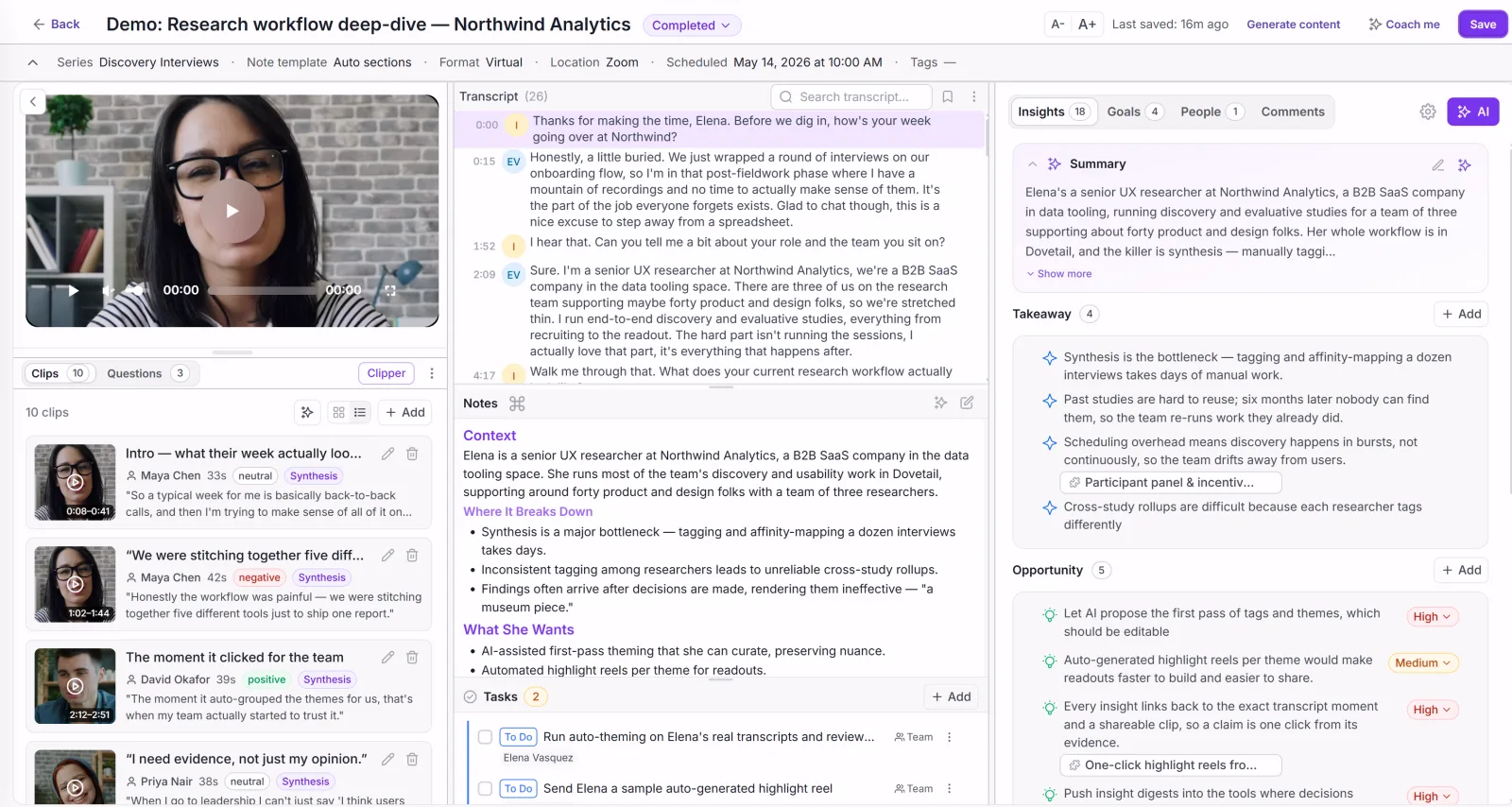
Intervool is the paid option here, and it does two things the free tools don't. First, it runs moderated usability tests: you pick what a session is testing — a feature, a flow, or an uploaded prototype or mockup — set a goal and success criteria, and work through your question template with the design beside you while it records. Second, it keeps them. Every session you run in Intervool, and every recording you upload from Maze, Lyssna, UXtweak, Zoom, or anywhere else, is transcribed and stored in one searchable place — no 14-day results window, no per-study report you'll never open again. Dynamic tags you define are applied across every session automatically, so nothing is hand-tagged, and what repeats is clustered into evidence-linked themes that carry into personas and a prioritized roadmap. It doesn't do unmoderated task testing at scale, so pair it with the free tools above for that. 14-day trial, no credit card, $39/mo after.
Best for
Teams who want their usability tests stored, searchable, and adding up to something instead of expiring on a free tier
Pricing
Basic $39/mo · Team $279/mo (6 seats) · Enterprise custom
Free option
14-day free trial, no credit card
Strengths
Moderated usability testing built in — including prototype and mockup testing
One searchable home for every usability test, whatever tool recorded it
Dynamic tagging — define your tags once, applied across every session
Reusable question templates so every session asks the same things
Themes, personas, and a roadmap, each linked to the session behind it
14-day trial, no credit card, flat pricing after
Limitations
No free plan — $39/mo after the trial
No unmoderated task testing at scale — pair with Maze, Lyssna, or UXtweak
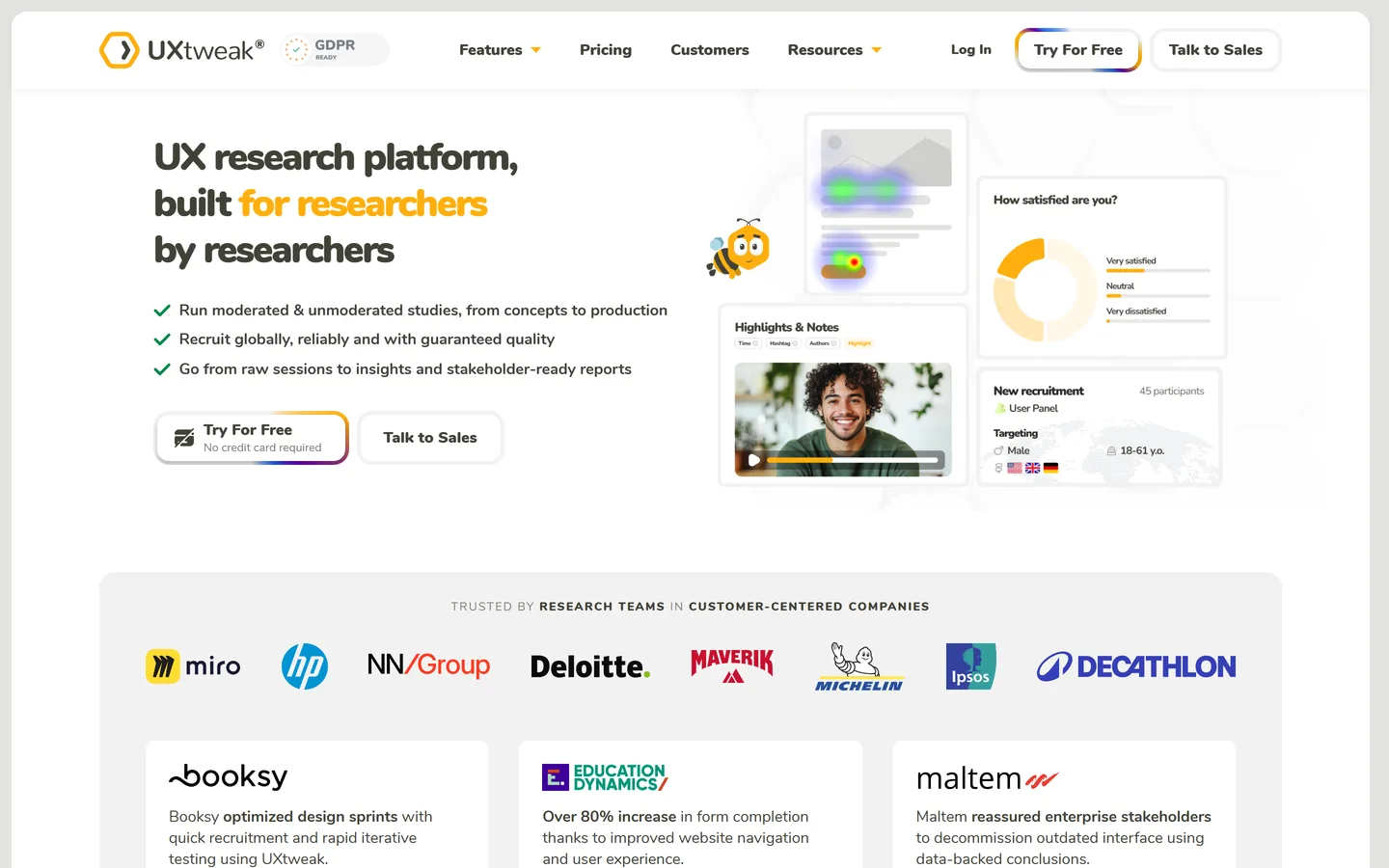
UXtweak's free plan is genuinely free and unusually wide: website and prototype usability tests, card sorting, tree testing, first-click and five-second tests, surveys, and session recording, for one user with 15 responses a month, one active study, and 14 days of access to results. That's enough to run a five-user test every month — which is most of the value — and it's the free tier we'd point a first-time researcher at. The limits that bite are the single seat and the result-access window; paid Business plans are quote-led rather than published.
Best for
A solo researcher or designer who wants real usability testing, card sorting, and tree testing at $0
Pricing
Business plan on request; Custom / enterprise quote
Free option
Free forever — 1 user, 15 responses/mo, 1 active study
Strengths
Almost every method available on the free tier
15 responses a month covers a five-user test
Own-panel recruiting on paid; bring your own users free
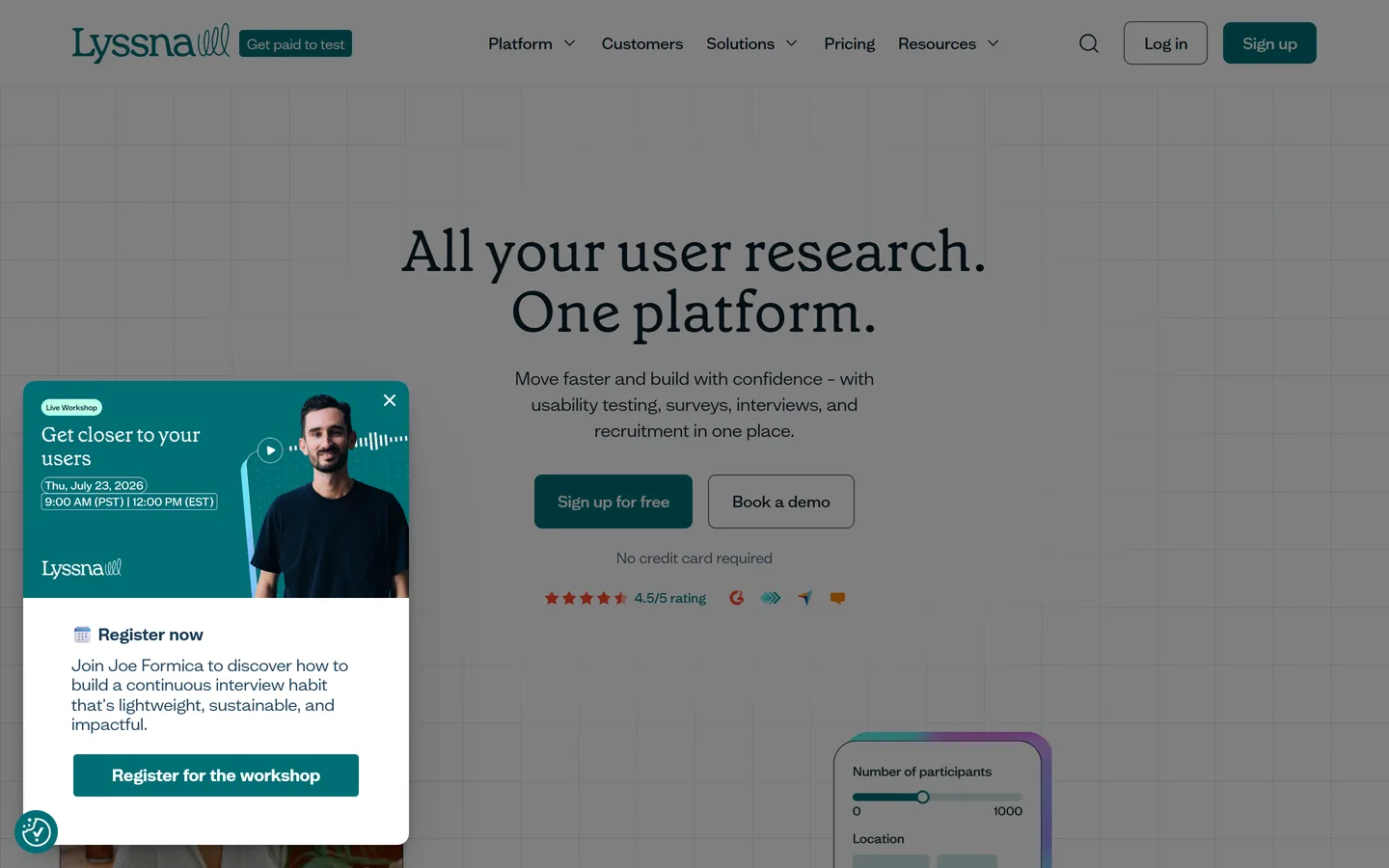
Lyssna's free plan gives three seats and 15 self-recruited responses a month across five-second tests, first-click tests, preference tests, prototype tests, card sorts, and surveys — the small, frequent studies that produce most of the value. It's the free tier that survives a second and third teammate. Its own 690,000-person panel is pay-per-response, so 'free' means testing with your own users; the Growth plan at about $166 a month is the next step.
Best for
Small teams who want quick five-second, first-click, and prototype tests without paying
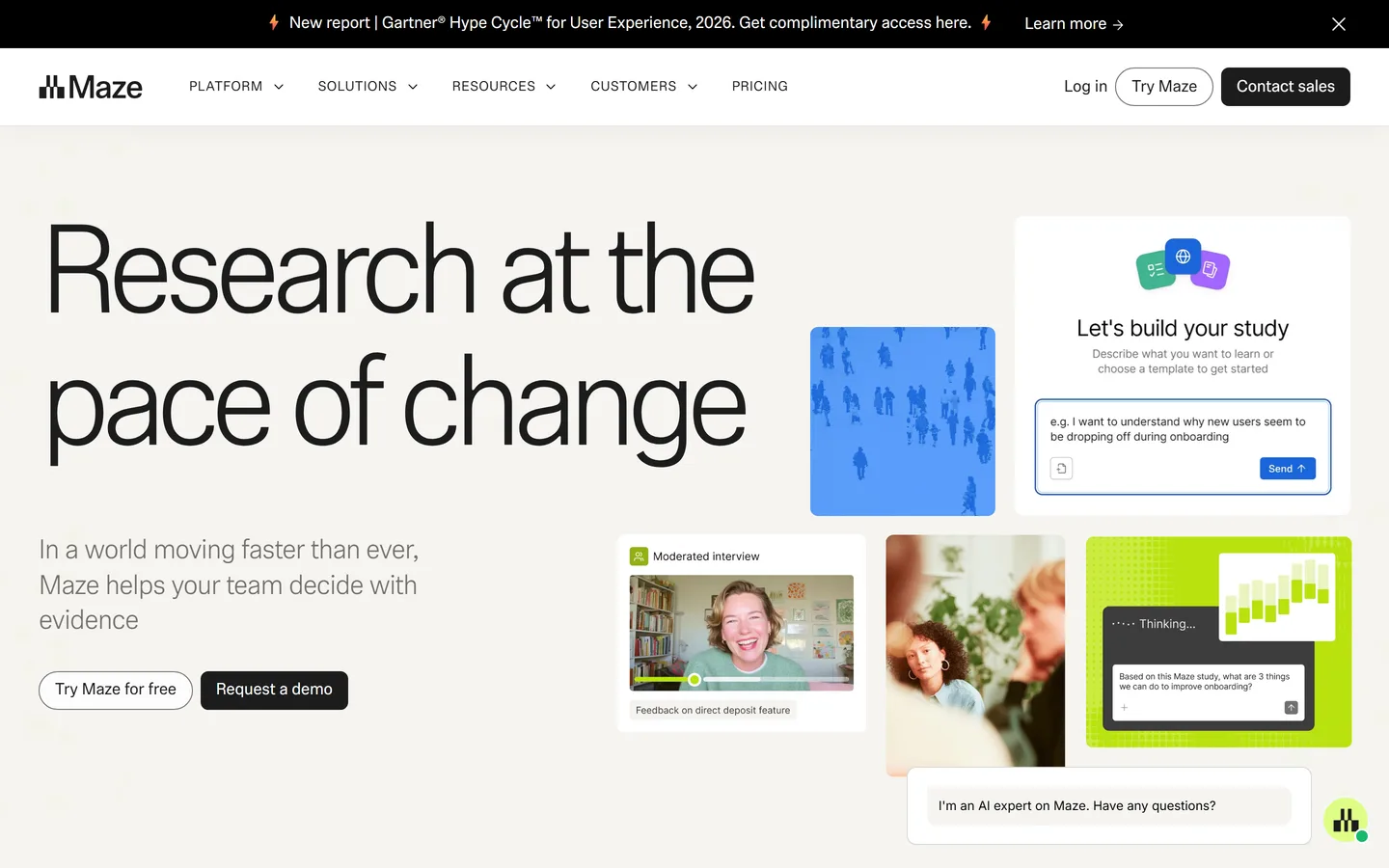
Maze's free plan lets you run unmoderated prototype and live-site tests with its Figma integration and see completion, misclick, and path results — the fastest way to validate a flow at $0. The caps are tight (limited studies and responses, one seat) and the jump to a paid plan is steep, but for one prototype test to settle a design argument it's hard to beat.
Best for
Designers who want to test a Figma prototype for free before buying anything
Pricing
Starter from ~$99/mo; Organization and Enterprise custom
Free option
Free plan with limited studies and responses
Strengths
Excellent Figma prototype testing on the free tier
Free prototype and live-site testing for one project
useberry.com
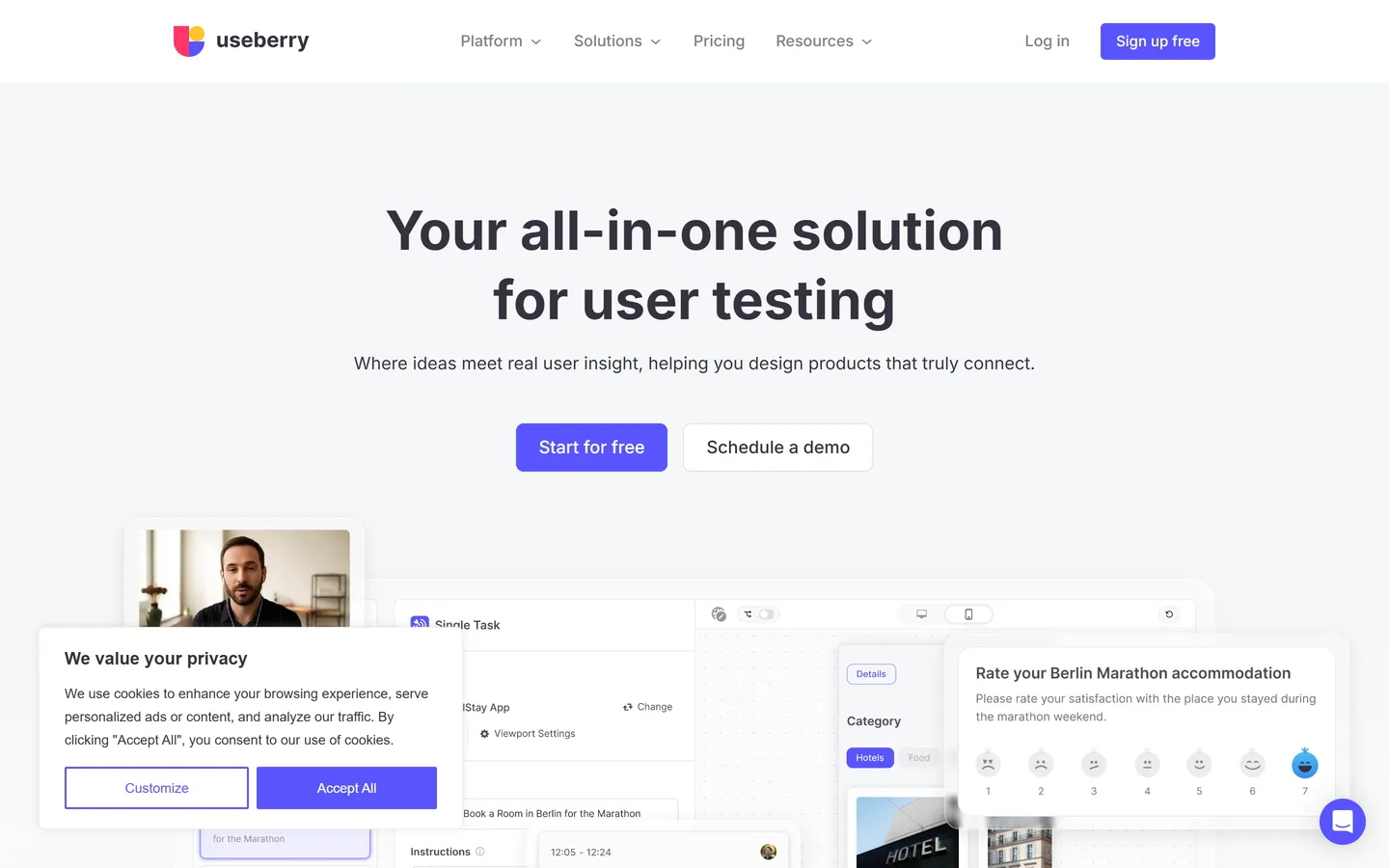
Useberry runs unmoderated tests on prototypes (Figma, Adobe XD, Sketch, ProtoPie) and live websites — task flows, first-click, five-second, card sorting, tree testing, and surveys — with heatmaps and path analysis. Its free plan is one seat, one project, and 10 responses a month, which is enough to learn the tool and run a small test. The Growth plan at about €83 a month lifts that to 300 responses.
Best for
A designer testing one project's prototypes and live pages
Pricing
Growth ~€83/mo; Business ~€659/mo; Enterprise custom
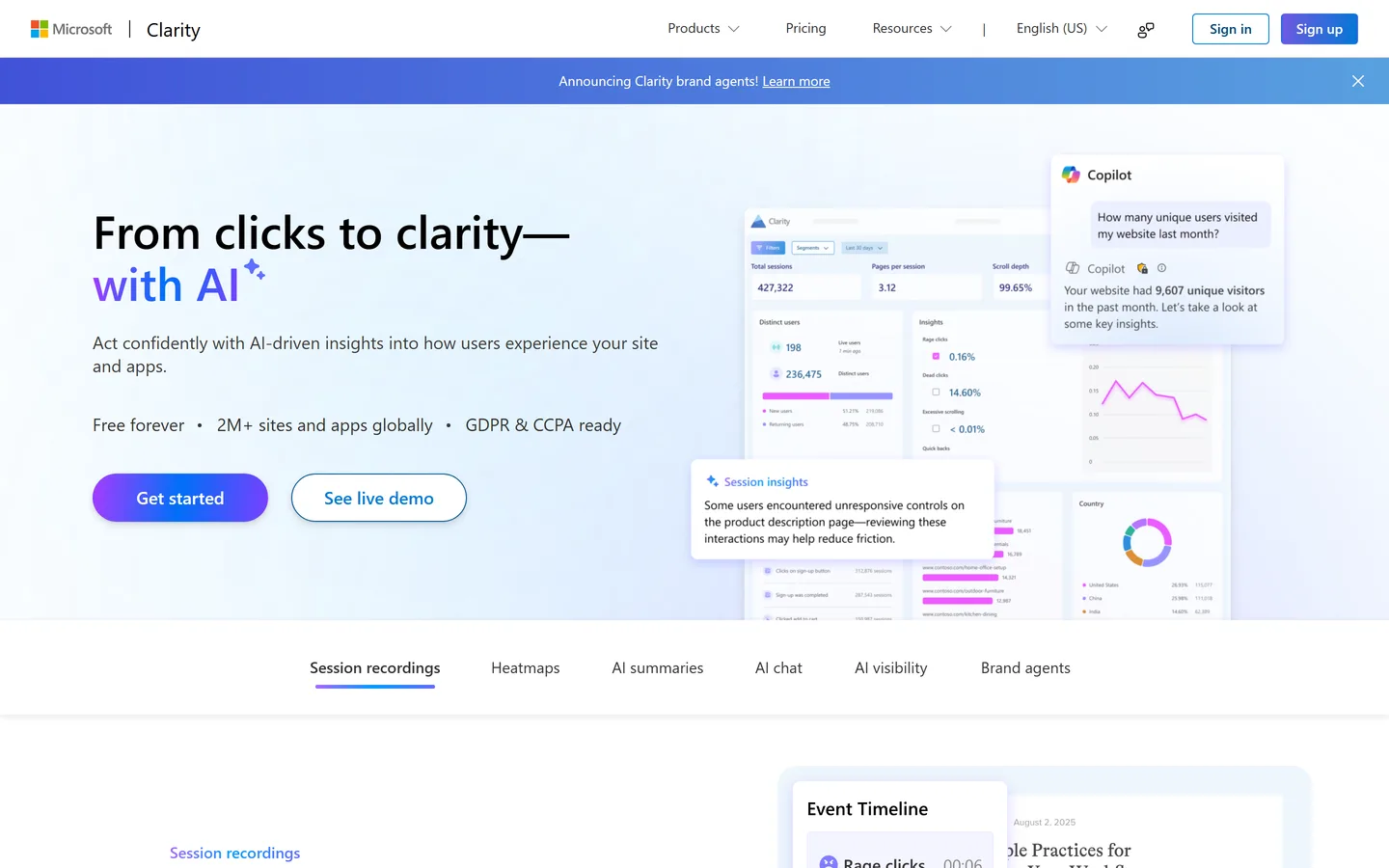
Microsoft Clarity records sessions, builds click and scroll heatmaps, flags rage clicks and dead clicks, and summarizes it with AI — and it is free with no traffic limits, no seat limits, and no paid tier. It's the single best-value free tool in UX research: install the snippet and you have behavioral evidence for every interview question you'll ask afterwards. It shows what happened, not why, and it has no testing, survey, or repository features.
Best for
Anyone with a website who wants to see where users struggle, at zero cost forever
Pricing
None — free forever
Free option
Free forever, no traffic or seat limits
Strengths
Completely free, no traffic caps
Rage-click and dead-click detection out of the box
Recordings, heatmaps, and on-site surveys on a small free plan
hotjar.com
Hotjar's free plan gives session recordings and heatmaps for a limited number of daily sessions, plus on-site surveys and feedback widgets — the combination of behaviour and a quick 'why?' prompt that Clarity doesn't offer. It's cheap to upgrade (from about $32 a month) when the daily cap starts truncating your data. Analysis is per-session; there's no cross-study synthesis.
Best for
Small sites that want replay plus on-page feedback widgets in one tool
Product analytics free to a million events a month
mixpanel.com
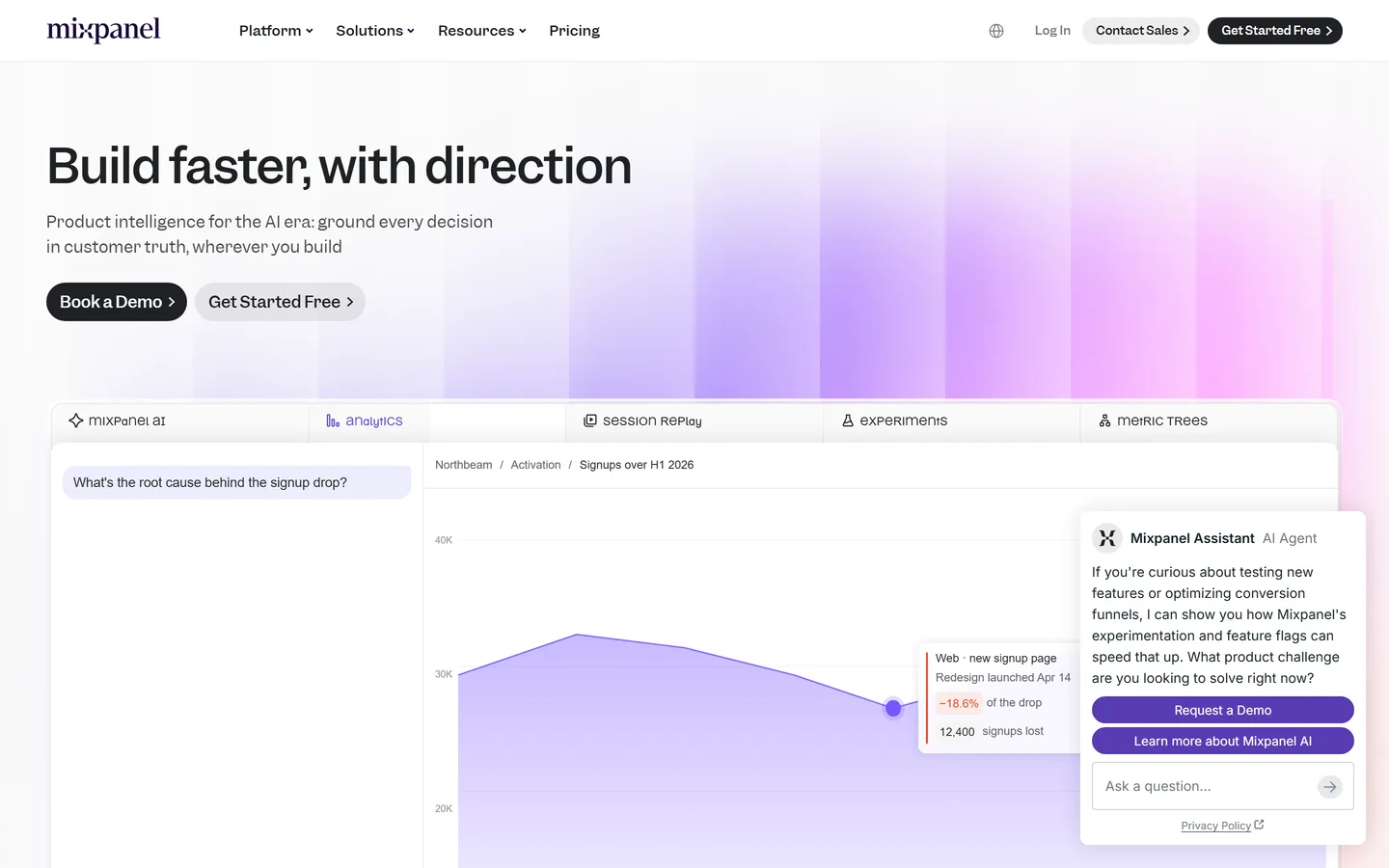
Mixpanel's free plan covers up to a million events a month with funnels, retention, cohorts, and session replay — enough for most early-stage products to run real quantitative analysis at no cost, and there's a startup program on top. In a research stack it tells you which flow leaks and which segment churns so your qualitative work goes where it matters. It needs event instrumentation, and it explains none of what it measures.
Best for
Product teams who want funnels, retention, and cohorts before deciding what to research
Tally is a form builder whose free plan has no limit on forms or submissions (under fair use), with logic jumps, file uploads, and integrations included — which makes it the best free way to run recruiting screeners and research surveys. Pro at $24 a month removes branding and adds custom domains and team features. It's a form tool, not an analysis tool: responses go to a sheet or your repository.
Best for
Screeners, sign-up forms, and research surveys with no response cap
The best-converting survey format, 10 responses a month free
typeform.com
Typeform's conversational one-question-at-a-time format produces higher completion rates than traditional forms, and its free plan lets you build unlimited forms and collect 10 responses a month. That's fine for a handful of interview follow-ups; it's not enough for a real survey, where the ~$25 a month plan starts. Tally is the better free choice for volume; Typeform for polish.
Best for
Occasional surveys where completion rate matters more than volume
The leading research repository, on a limited free tier
dovetail.com
Dovetail's free tier gives a single user a taste of the market-leading repository — upload sessions, transcribe, tag, highlight, and search — with limits on data and collaboration. It's enough to organise a small study properly and to learn the tagging model, and it's the only credible free repository option. Once a team needs to share it, per-seat pricing from about $29 a month starts, and it stays a repository: you do the analysis, it keeps the results.
Best for
One researcher who wants a proper place to tag and search a small number of sessions
Every tool here has a permanent free plan, not a trial — except Intervool, which is marked as paid and included for the gap free tools leave: somewhere to keep usability tests and make sense of them together. Trials that expire (Lookback, Loop11, Optimal Workshop, Looppanel) are on our main UX research tools guide instead.
We stated the limit that actually bites
Vendors advertise the headline feature and hide the cap. We list the response, seat, and traffic limits from each pricing page as of August 2026, because a free plan with one seat quietly stops being free the day a colleague needs access.
We assembled a whole free stack
The useful question isn't 'which free tool' but whether you can run real research at $0. You can: UXtweak or Lyssna for tests, Clarity for behaviour, Tally for screeners, Dovetail to keep it. The tools were chosen so the categories add up.
We drew the line honestly
Free tools are excellent at running an individual test or recording a session and consistently poor at telling you what thirty of them mean. That synthesis is where budgets go, and we say so rather than pretending a free plan covers it.
FAQ
Common questions
What are the best free UX research tools?
UXtweak and Lyssna for free usability testing (15 responses a month each; Lyssna allows three seats), Maze and Useberry for free prototype tests on tighter caps, Microsoft Clarity for completely free session replay and heatmaps, Hotjar and Mixpanel for free behavioral analytics with limits, Tally for unlimited free surveys and screeners, Typeform for 10 responses a month, and Dovetail for a limited free research repository.
Can you do UX research for free?
Yes, for a small team. A working $0 stack is UXtweak or Lyssna for unmoderated tests with your own users, Microsoft Clarity for behaviour, Tally for screeners and surveys, your own calendar and video tool for interviews, and Dovetail's free tier or a spreadsheet to keep findings. What you can't get free is a large participant panel or automated synthesis across many sessions.
Is there a completely free usability testing tool?
UXtweak, Lyssna, Maze, and Useberry all have permanent free plans for unmoderated usability testing. UXtweak's is the broadest in methods; Lyssna's allows three seats; Maze's is best for Figma prototypes; Useberry's supports the most prototype tools. All cap responses at 10–15 a month, which still covers a five-user test.
Is Microsoft Clarity really free?
Yes. Clarity has no paid tier and no traffic, seat, or retention caps as of August 2026. Microsoft funds it and uses aggregate data to improve its products; read the privacy terms if that matters for your users.
What's the best free alternative to UserTesting?
For unmoderated tests with your own participants, UXtweak or Lyssna's free plans. UserTesting's real value is its large panel and video feedback, which no free tool matches; Prolific and User Interviews are free to sign up and charge per participant if the panel is what you need.
Where does free stop being enough?
Usually at one of three points: you need panel participants you can't recruit yourself, a second teammate needs a seat, or you have more sessions than you can synthesize by hand. The first two are cheap upgrades within these tools. The third is a different category — tools that store and synthesize sessions, like Intervool, from $39 a month.
Is Intervool free?
No. Intervool has a 14-day free trial with no credit card, then costs $39 a month for Basic or $279 a month for a six-seat Team plan. It's on this page because it runs moderated usability tests and then keeps them — every session transcribed, tagged, and searchable — which is the part free tiers stop short of. You can upload recordings from any tool on this page into the trial.